
Commercial renovations are not just about improving a space.
They are about protecting your business.
Unlike residential projects, commercial work comes with tighter timelines, stricter regulations, and real operational consequences if things go wrong.
When delays happen, you do not just lose time.
You may lose:
- Revenue
- Staff productivity
- Tenant stability
- Customer confidence
The right planning and the right contractor can be the difference between a controlled project and one that becomes an ongoing disruption.
Before you move forward, there are a few critical things every business owner should understand.
Vetting Your Contractor
A commercial contractor is different from a residential contractor.
The stakes are higher.
Timelines are tighter.
Requirements are more detailed.
The consequences of mistakes are more serious.
In addition to standard qualifications like licensing, insurance, and WCB coverage, these are important questions to ask from day one:
- Do they show up on time?
- Do they treat your project as a priority?
- Do they follow a clear and repeatable process?
- Do they understand how your business operates?
- Are they realistic about timelines?
- Do they have the team and trade relationships to deliver on those timelines?
These questions are not about being difficult. They are about clarity.
A contractor who communicates clearly and sets realistic expectations early is far more likely to deliver a steady project.
Price will always be part of the decision. But in commercial work, organization and structure often matter more than the lowest number on paper.

Planning Comes Before Construction
Most project problems don’t happen during the build.
They happen because planning was rushed.
Before we start a commercial renovation, we focus on:
- Clear scope of work
- Realistic timelines
- Trade coordination
- Documentation
- Budget alignment
- Understanding operational impact
When this is done properly, construction becomes execution — not problem solving.
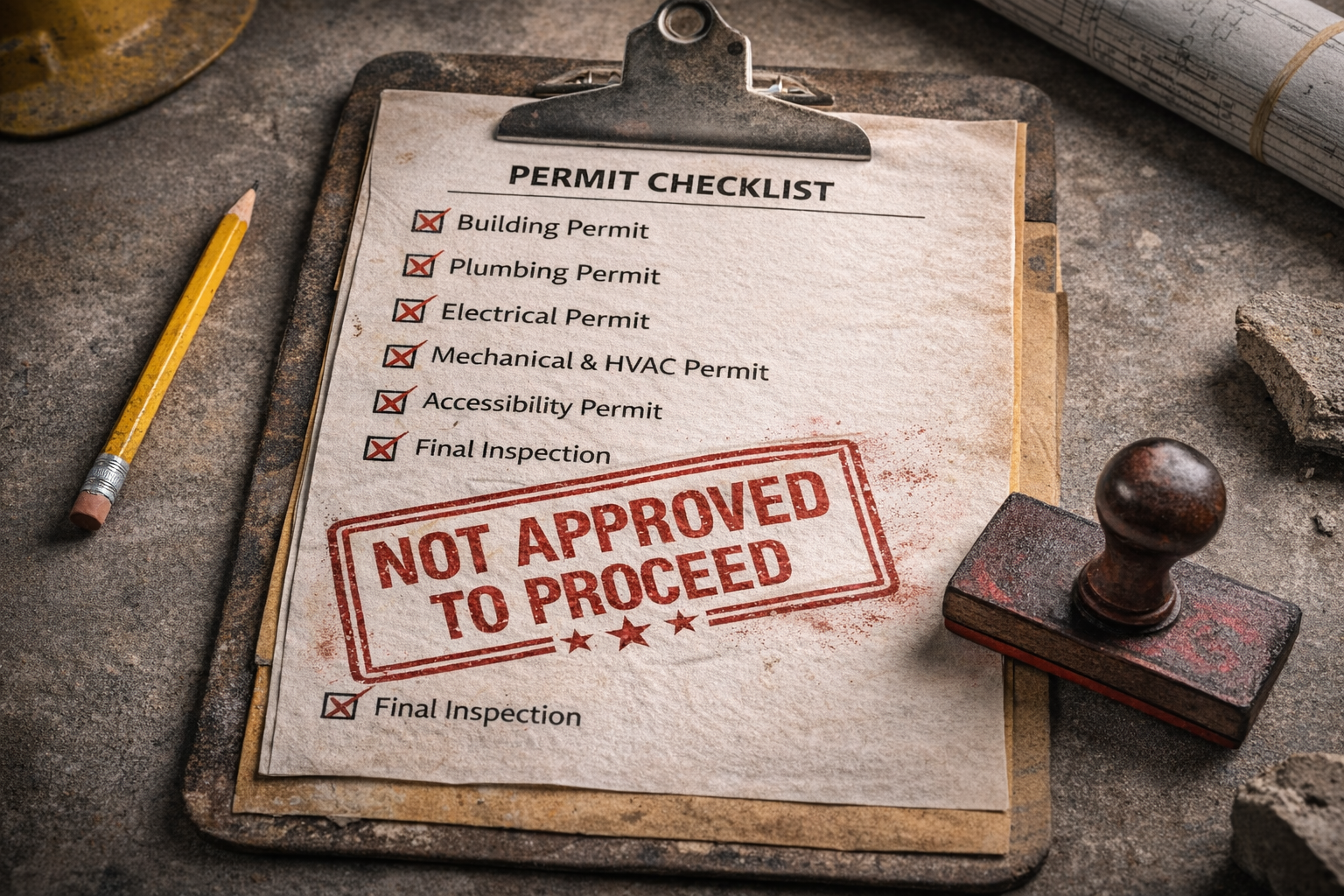
Permits and Code Compliance Are Not Optional
Some companies choose to operate in the grey.
They may start before permits are issued. They may try to avoid city involvement. They may cut corners to move faster.
On the front end, this can seem like a reasonable shortcut. In practice, it often leads to:
- Permit delays
- Failed inspections
- Stop work orders
- Last-minute corrections
- Delayed occupancy
Building properly from day one helps ensure the project finishes cleanly and without unnecessary stress.
Skipping steps rarely saves time or money in the long run.
Coordination With Trades Matters
Commercial spaces involve multiple trades working together, we often have as many as 10 different trades involved with the build of a single space.
Without coordination, projects stall.
Good commercial renovation projects are scheduled carefully. Each trade knows when they are coming in, what they are responsible for, and how their work connects to the next phase.
Another important factor is subcontractor relationships.Some contractors move from trade to trade, burning relationships along the way. This can lead to:
- Warranty issues
- Quality concerns
- Scheduling instability
- Builder liens if trades are not paid
We choose to work with the same certified trades repeatedly. They know each other. They understand expectations. They hold each other accountable.
Strong relationships create stability. Stability leads to better outcomes for the client.
Don’t Become a Horror Story
We hear many renovation stories in this industry.
Most of them share similar themes:
- A lack of trust between owner and contractor
- Poor planning
- Unclear schedules and processes
- Choosing based only on the lowest price
After working alongside many contractors over the years, one pattern stands out.
The lowest upfront price often comes from the least organized contractor.
In the end, that contractor can become the most expensive on site due to delays, deficiencies, and unexpected costs.
Commercial renovations require discipline and structure.
When you invest in proper planning and choose the right contractor, the process becomes steady and predictable.
A little prevention at the beginning protects a lot at the end.
